During July 1981 the meditation group hosted a series of programmes at U.N. Headquarters high-lighting the cultural and spiritual traditions of the major regions of the world.
The first of the series (focusing on the Latin American region) was held on 7 July.
The guest speaker was Mr. Lucien J. Henar, Deputy Permanent Representative of Suriname to the United Nations.
A statement from H.E. Mr. Davidson L. Hepburn, Permanent Representative of the Bahamas was also read out.
Excerpts from the text of Mr. Henar’s remarks and Ambassador Hepburn’s statement follow.
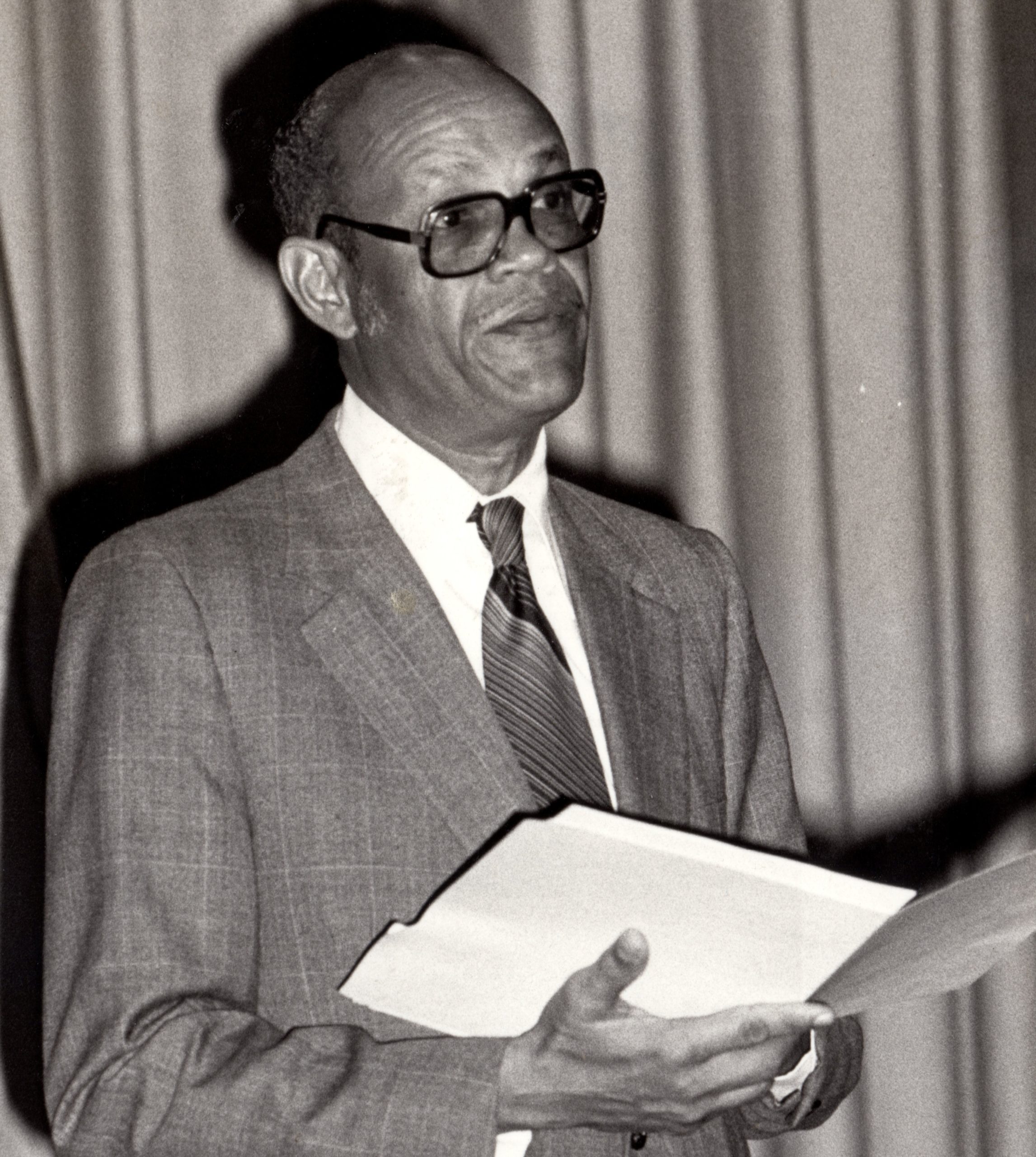
1981-07jul-07-Region-Prog-Latin-America-Lucien-Henar-Dep-Perm-Rep-Suriname-scaled.jpg – 833 KB
His Excellency Mr. Lucien J. Henar, Deputy Permanent Representative of Suriname to the United Nations:
Thank you. Before answering the question of how Suriname contributes, or I would rather say hopes to contribute, to cultural and spiritual solidarity in Latin America, in my opinion, another question must first be answered, namely whether it is legitimate to consider the continent as a unified entity. Expressions such as “Latin American nationalism” or “internationalism” are often used to stress the importance of Latin American unity. The cohesiveness of the region can be traced back to common historical, religious, racial and cultural links. Almost all of the Latin American peoples have a similar Indo-Iberic and partly African back-ground, which, throughout the years, has provided a common factor unifying the populations. Tl.e similar historical experience of emancipation from the yoke of the Spanish empire, more than 150 years ago, also produces an added feeling of com-mon identification. Generals like Jose de San Martin or Simon Bolivar, who participated in the general movement of independence from Spain, are considered heroes for the whole of Latin America and represent the ideal of unity in Latin America.
The population of Latin America is 90 percent Catholic, which means the greatest concentration in any area in the world. The region also has cultural and linguistic homogeneity, since Spanish is a unifying link. What is the case with Suriname? The people in Suriname do not have an Indio-Iberic background.
The majority of the people of Suriname are of African and Indian descent. The English and Portuguese introduced Negro slaves from Africa as early as the 16th century to do the hard work on their plantations. When the Dutch conquered Suriname in 1667, they also took over the slave trade and brought Negro slaves to Suriname. In 1863 the Negro slaves in Suriname threw away the yoke of slavery of the Dutch. After the abolition of slavery, Chinese, Indians and Javanese were brought to the Dutch colony to work on the plantations as contract labourers.
Up to the present day the official language of Suriname has been Dutch and the majority of people in Suriname have other religions than the Roman Catholic. Since the independence of Suriname in 1975, the country has tried to put its best foot forward to integrate into the region and, in doing so, it is trying to promote the unity and progress of Latin America. Spanish is now being taught in all secondary schools, and there are many private institutions, like the Andres Bello Cultural Centre in Paramaribo, which make a great contribution to the knowledge of the Spanish language in Suriname. Suriname has become a member of the Organization of American States, as well as several other regional groups, and maintains diplomatic, cultural and commercial relations with many countries in the region. Although the contribution of Suriname to cultural and spiritual solidarity might not have been substantial in the past because of historical and other reasons, we can say that the quest for integration in Latin America has manifested itself in many ways. Hopefully this will gradually result in a greater contribution of Suriname in the years to come.
Statement by H.E. Mr. Davidson L. Hepburn, Permanent Representative of the Bahamas tu the United Nations
It seems to me that as transportation and communications systems make our universe smaller, mankind in general is endeavouring to form closer ties of friendship and brotherhood. This attitude is keenly felt in the Latin American region where programmes are specifically geared to promote better understanding and cooperation. Bahamians, for example, are being taught Spanish and French in public and private schools. Young people are urged to study the culture and custom of their neighbours. Consequently, the differences are beginning to disappear and are being replaced by that inherent spiritual bond which transcends selfishness and isolation. Based on these and other observations I am confident that our region is determined to exemplify that familiar adage: “Unity is strength.” 10