Tribute to Nelson Rockefeller 2 Feb 1979
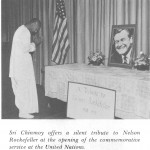
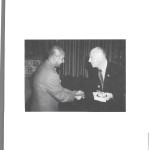
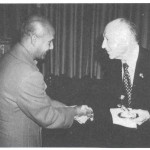
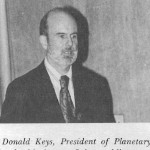
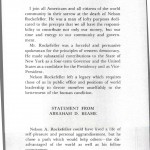
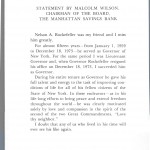
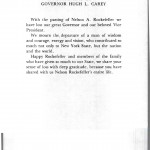
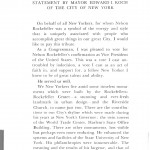
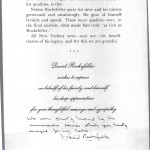
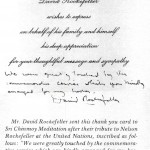
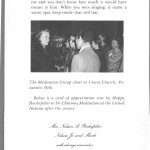
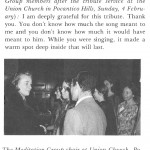
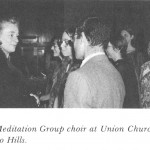
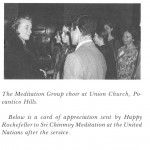
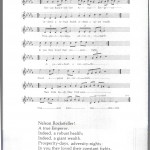
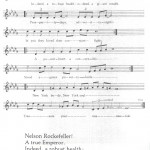
Filed under americas | MG Members in other events | Tributes and Expressions of appreciationOn 2 February 1979 United Nations diplomats and staff joined members of the Meditation Group in a tribute to Nelson Rockefeller, held in the Dag Hammarskjold Auditorium at New York Head-quarters. The programme opened with silent meditation led by Sri Chinmoy and the singing of his new song dedicated to Nelson Rockefeller by the Meditation Group choir. New York Senator Jacob Javits, former New York City Mayor John V . Lindsay and Mr. Donald Keys of Planetary Citizens then offered moving and significant personal accounts of Mr. Rockefeller and statements were read out from U.N. ambassadors and U.S. Government officials. Sri Chinmoy Meditation a t the United Nations was invited to sing the Rockefeller song again at a February 4th tribute service at the Union Church in Pocantico Hills, which was attended by Mrs. Happy Rockefeller as well as t he Laurence Rockefellers. A transcript of the United Nations service as well as the statements follow.
(text below here needs to be cleaned up from cut and paste of report)
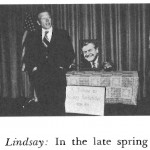
Mr. John Lindsay:
In the late spring of 1946, after serving three and a half years as gunnery officer In a United States destroyer In the Mediterranean, Atlantic and Western Pacific Oceans, coming out of the war back to my home town of New York City, taking a look at the shattered world around, much of it in ashes, with one-quarter of my class at St. Paul’s School in Concord, New Hampshire having been killed and almost that proportion of my class at Yale University having been killed in the war, one wondered what to do next.
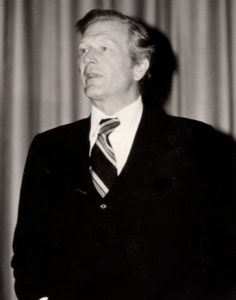 There are a lot of us who survived who vowed to ourselves that this would never happen again. Well, an extraordinary thing happened, which is that this institution known as the United Nations was created. And I don’t suppose that there are a huge number of Americans or New Yorkers who are still vitally aware of the fact that it was the Rockefeller family that made it possible, that their vision, led by Nelson as much as any other member of the family if not more, assembled this plot of land and made it available , provided resources by which it could be bought, and provided much of the inspiration and certainly most of the practical power which made possible the creation of the United Nations as an institution and cleared the way for its positioning here in New York City. We’ve had it ever since. It h as had its ups and downs; and I like to think, as a person who is a deep believer in the body of the United Nations, they’ve been mainly ups. If it were not here, if it did not exist, it would have to be invented of necessity. It is a place to which people come when all is in disrepair and on the brink of chaos. One has to attach the Rockefeller name to that and most especially Nelson Rockefeller’s name. And today especially I think it’s worth reminding ourselves, as was done at that perfectly beautiful service at the Riverside Church at II o’clock this morning, of the Rockefeller vision and especially of that enormous and special energy that was Nelson Rockefeller’s electric energy. It was always attached to the vision that he had for his community, for Americans and for the world. One can say much about Nelson Rockefeller, but I think if you had to put your finger on the thing that was the most special quality of all, it was the breadth of his vision, seeing as far to the horizon as any other human being in modern society that I can think of, and being prepared and willing to follow the dream that came out of that enormously incisive vision that he had. It’s hard to find qualities of leadership today, it’s hard to find men and women who possess that faith in the country as well as in themselves that allows them to pursue a goal always guided by some internal gyroscope that points to the North Star. One gets to an age where one concludes that the most important thing of all is an integrity in people. Most other parts of their lives, most other choices that they’ve made are relatively unimportant when compared or measured against that quality of character -integrity, decency, honesty and leadership. What Nelson Rockefeller had of that was in abundance. And I would suppose that much of it came from the heritage that he had: belief in family, belief in God-a practising Christian father and mother, a united family that respected their parents and grandparents and indeed openly sought to pursue goals that had been passed on to them by their parents.
It is worth remembering that it was in the depths of the Depression that Nelson’s father, John D., with young Nelson at his side for the entire adventure, under the tormenting criticism of economists and others in the Depression, went forward with the construction of Rockefeller Center, surviving also the fears of some critics in the field of architecture and design. Today it is cited and applauded worldwide as a model of urban design, as a civic and business center of enormous importance, as a “people place” and as an institution that works in the private sector, in the American way, for profit. It was the same here, with the United Nations, the faith that went in to the construction of that. It was the same faith -that appeared in so many different aspects of the life of this remarkable leader for whom the memorial service .’ was held at Riverside Chapel today and thought-fully and wisely and splendidly being held here in the Dag Hammarskjold Memorial Auditorium at the United Nations-a combination of meditation, thoughtfulness, thankfulness and some zest and joy. It is most certainly true, as has been mentioned by many today at the services at 11 o’clock-and I think I can testify to this from personal experience – that there was never once heard from Nelson Rockefeller a note of, what shall I say, cynicism, sourness, self-pity, disappointment over personal things. He genuinely had the belief, which he held in all modesty, that he had an obligation and -duty~ which are from being born with wealth and power, to serve and to serve other people – even though he could be at times very aggressive and pugnacious, and at times a very tough fighter indeed with those with whom he disagreed (although those disagreements were always done with respect). He never pursued any political goals he had as a personal thing. He pursued them in the nature of trust, as a trustee, as a person who should serve and wanted to serve. But in that also he under-stood power and he understood that the game of politics was useful only as a tool of government. Now the art of government again was the art of being a trustee in respect of the well-being in the lives of other people. A deeply compassionate man in the right sense, in a quite modest sense in many ways, he felt very deeply that there were many other people in this world, millions of them, who were less fortunate than himself. He was indeed, as was pointed out in the services this morning, quite genuinely his brother’s keeper. So I think it is more than fitting and appropriate that we are here in this signally important place on the East River of New York City which, thanks to Nelson Rockefeller as much as any other man that I can think of, is the world capital -the city that is the home of more international things than any other city I can think of including Geneva, particularly in its people. It is right and proper that these moments be spent at the United Nations in this auditorium reminding ourselves that this place, and our community, our country and indeed the world are probably better because Nelson Rockefeller passed through them. I think it’s worth remembering too that he was a man who refused to look backward and always looked forward. And no matter what the mountains were ahead, he looked forward to climbing them with tremendous zest and joy. He relished problems and difficulties because they could be dealt with and he liked dealing with them. Every problem was an opportunity as he saw it.
So I think this is his great legacy at the moment to this institution which he did so much to help. Most particularly in today’s rather cynical world, the United Nations should remember that all of the problems that lie ahead with which it can deal, are opportunities for growth, peacekeeping and the betterment of the lives of millions of people the world over who in so many corners of the world depend upon the energies of this institution. In a way, what the United Nations stands for and what it does in all of its parts the world over is an extension of what Nelson Rockefeller stood for and what he tried to do during his life. So I as a very proud New York citizen am very happy to share in this ceremony here to reflect on the life of this very important person and, as he always did, to look forward to the complicated time and years ahead with a lot of joy. I think indeed they’re going to be tough ones, but we need joyous and well-spirited men and women to take on those problems and do something about them and attempt to solve them. With days like today, we’ll do it
Senator Jacob Javits:
Ladies and gentlemen, I’ve just come down from the memorial service for Nelson Rockefeller. When I was asked to appear here at the United Nations in the Dag Hammarskjold Auditorium to say a brief word of memorium to Nelson, I just couldn’t refuse. I felt it was my duty and a great privilege, especially in this atmosphere. Nelson Rockefeller was by no means an unmixed character. He had a lot of faults as well as fantastic virtues. And you have with you today two eloquent witnesses to both – John Lindsay and myself. We have dealt with him in the most intimate terms for the most active years of his public life. But uniquely, here, one can only speak of his strengths.
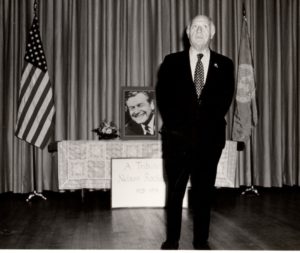 There was one thing that distinguished him, and it was interesting how it permeated everyone of the memorial statements which were made at the Riverside Church a very short time ago, by Ann and Rodman, two of his children, by Henry Kissinger, who made an eloquent, brilliant dissertation really, and by the ministers, Dr. Sloane Coffin and Dr. Martin Luther King, Senior. What shone through it all was the size of the man ‘s mind, the grasp of his imagination. If there is any memory I have of Nelson Rockefeller, it is that he was capable of envisaging great things. Dr. Kissinger pointed something out which I understand and John Lindsay will understand and which I’d like to communicate to you. And that is that Nelson Rockefeller found it very difficult to communicate his ideas. Now that is an interesting thing to say about a public man, but he was not that eloquent, that able to phrase a proposition. But he certainly was able to conceive it. He had unbelievable dynamism in doing. And these very properties on which this great institution stands are a tribute to exactly that kind of dynamism and that kind of brilliance of imagination because you know these lands were designated by the Rockefellers and Nelson was the mainspring. And again,
 I happen to know that very intimately because one of my first opportunities in the House of Representatives in my first term in 1947 and 1948 was to sponsor the UN loan that made this whole enterprise possible, including its location in this ver y great city, of which my friend and colleague John was the Mayor, very, very ably and for such a long time. So that’s the one thing about Nelson Rockefeller that’s the greatest memorial to him and he showed that in many ways. The story was told this morning that as a very young man in the depths of the Depression he took on the Rockefeller property, what’s called Rockefeller Center, and made a success of it. His concept of a hundred billion dollars, which our country rejected most unwisely, to break the grip of the OPEC cartel upon the world, politically and economically, of its control of oil, was a brilliant concept. We’ll be spending that probably anyhow except that we won’t get nearly the benefit out of it which comes from a massing of means at a given time when it’s the most opportune. And in his personal relations, which will interest you, especially you young people so much, he also had that same spirit. He might fight like a tiger at me over something that he did that I opposed (that was unforgivable to Nelson). And it was his nature, but he could also be the most endearing, the warmest, the most embracing friend that you could ever imagine, with the same complete dedication with which he got angry. And then of course his love for the arts is really inspiring. I don’t know of a happier moment in his life than the one some eight or ten years ago when he took a tour through the Museum of Modern Art on television and communicated to the whole world his depth of feeling and his understanding and what he read into the great artistic manifestations, especially contemporary art, that he showed. And finally, he had an unusual relationship with his family. He did have problems as you all know in his domestic life, but when it came to the sense of family as an institution, he was really most extraordinary in terms of time, in terms of patience, in terms of the love which he poured out and in terms of the lessons he taught and the pride which he took in the successes of his own children as they occurred around him. So, this was a monumental man with a great influence on his time, the kind of man whose influence will be greater now perhaps because it was all tied up with the ambition and disappointments of political life while he lived. But now it’s unalloyed. You can see the size of his mind, the grasp of his imagination, the contribution of all the committees and groups of experts who developed his ideas. The ideas were great and now we have them in a pure form, unmixed with why he did it or what purposes he had or was seeking to promote and so on. He was a great mind, a great personality, who accomplished great things in our state. Again for the young people here, let us take the development of the New York Stat e Universities: fantastic! They came from absolutely nothing to hundreds of thousands of students and rivaled the greatest system of that character in our country, perhaps in the world, which is in California, and even exceeded it in terms of the individual excellence of a good many of the institutions which have developed. He revolutionized the opportunity for higher education in this state. This is an extremely critical model for the country. And so it was in field after field , even in what he was somewhat ridiculed, such as his vast expenditure in Albany – the mall. It is magnificent; you know if you’ve seen it. If not, you really ought to have a pilgrimage to see it. Ultimately, just as right here in our own city Lincoln Center will revolutionize the West Side , so the mall in Albany will revolutionize central New York .
It’s so radiant, so exciting, so much of an example of the power and imagination of man. So I join with you today in this tribute to Nelson, uniquely in the U N, for this was a man of a truly world view and a world comprehension and the ability to conceive of man’s future in terms of the infinite richness of what the world both technologically and artistically affords.

1979-02feb-02-trib-Nelson-Rockefeller-Sri-Chinmoy-Meditates-scaled.jpg
He well deserves your tribute as representative of the diverse peoples of the world, and I believe his teachings and his services have an enduring debt to those values which I know you do and I do worship together and which this institution is intended to embody. Thank you.
Gallery:

-

- 1979-02feb-02-trib-Nelson-Rockefeller-former-mayor-John-Lindsey
-

- 1979-02feb-02-trib-Nelson-Rockefeller-Senator-Javits-NY
-

- 1979-02feb-02-trib-Nelson-Rockefeller-Senator-Javits-NY-crp-01
-

- 1979-02feb-02-trib-Nelson-Rockefeller-Sri-Chinmoy-Meditates-scaled.jpg
